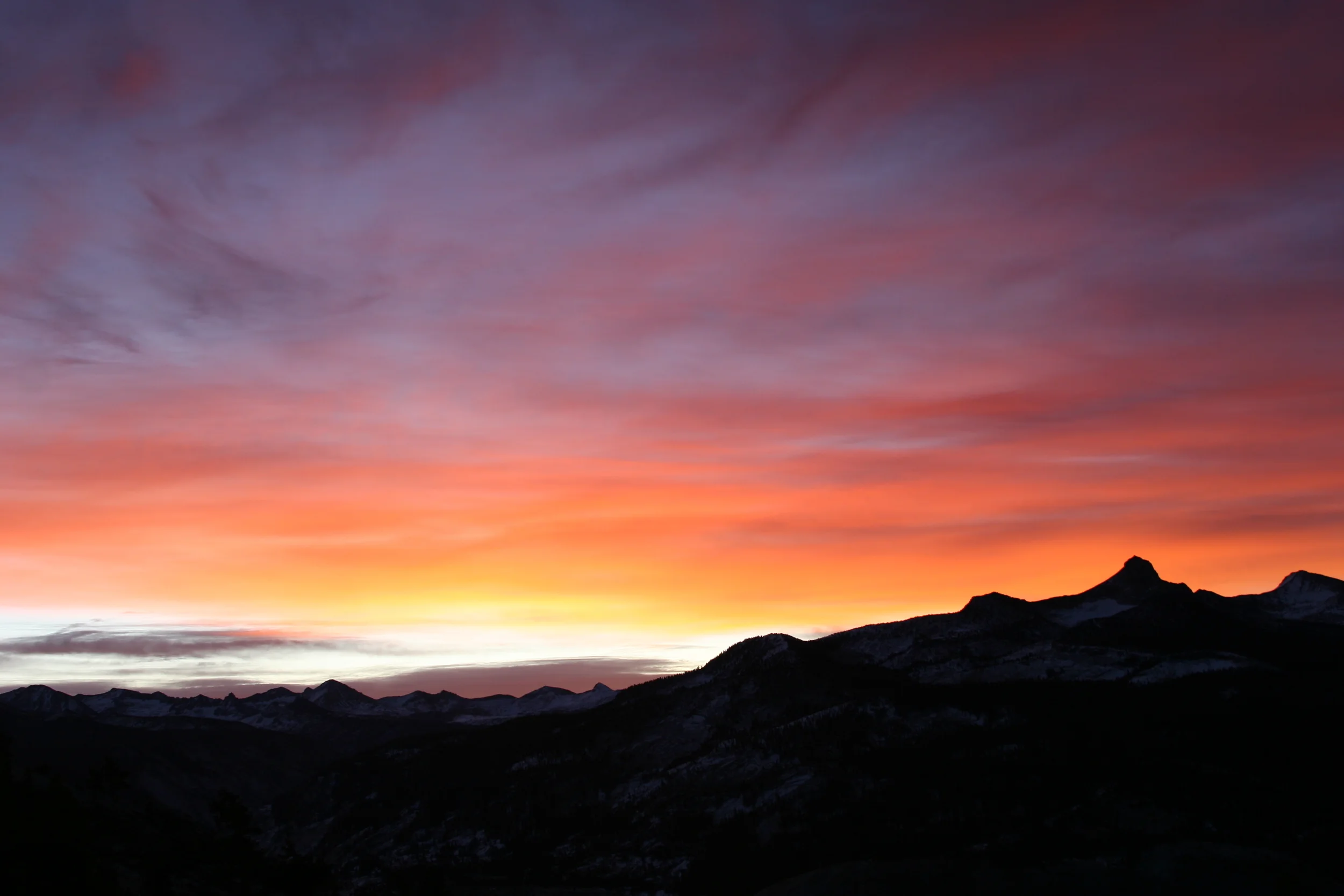
Tunnel View, Yosemite National Park

Tunnel View, Yosemite 2010

I know this place. It’s a place unlike any other on earth, it’s magical, it’s mystical, it’s beautiful, it’s amazing, it’s stunning, it’s everything that you’d want the wilderness to potentially be; and it’s only visited by millions of people a year. It’s called Yosemite. You might have heard of it. I’d like to sit here, and tell you all sorts of amazing things about Yosemite, about the park’s history, about the park’s geology, about the park’s geography, and about everything in between. But you know what? That’s all been written. And for me to say that sounds a little bit like a cop-out, but let me be honest with you: in that respect, there’s nothing I can tell you that hasn’t been written in a better researched and more thorough way by other professionals. (Besides, you know that I’m going to mix in some facts in with my articles, anyways, so there’s nothing to be too depressed about, really. If you’ve never been to Yosemite – do the research, whether you’re starting here, or anywhere else, and prepare to be fascinated).

What I am going to tell you is the things I know based on personal experience, of having been a park visitor for all these years; and an employee of the Backcountry division of the National Park Service for one season. These facts and tips make up for any lack of specific knowledge that I might have in certain areas. I know Yosemite like the back of my hand. I know it like the back of both hands, actually, because it’s a big place – as big as Rhode Island. I know the trails. I know the plants. I know the animals, and I know the climbing routes. I know these things because I’ve been there, and I keep going back. That alone should tell you something: the person who loves solitude and hates crowds more than anything keeps returning to a place that attracts millions of people. Yes, for me Yosemite is also “Mysemite” (http://www.amazon.com/Mysemite-Sketches-Warren-Cederborg/dp/1425954952), and it can be Yoursemite too, because it is that special.

 Tunnel View, Yosemite 2002

So let’s get started. There’s a lot to cover, and while I’ll be talking about winter activities primarily in Yosemite for the next couple weeks, there will be other posts about Yosemite in the following weeks and months. The best time to visit Yosemite? Any time, the park is stunning at all times. However, be aware of two things: if you go in winter, be prepared for winter conditions – snow, ice, and all that fun. If you go in summer, be prepared for lots of people, and sometimes, winter conditions at higher elevations. As for spring and fall? Be prepared for a mixture of all of the above.

As for the easiest-to-get-to-best-view-in-the-park, the answer can only be one thing: the Tunnel Viewpoint off of Highway 41. (http://www.nps.gov/yose/naturescience/scenic-vistas-tunnel-view.htm, http://www.nps.gov/yose/planyourvisit/viewpoints.htm). The viewpoint is directly off of Highway 41, and is accessible from both the North and South side of the highway. Should you have entered Yosemite from the South Entrance on Highway 41, the viewpoint will be right in front of you once you exit the Wawona Tunnel. Should you be headed out of Yosemite Valley to the southern portion of the park, the viewpoint will be on your immediate right after you pass the Lower Bridalveil Fall parking area, and before you enter the Wawona Tunnel.

 The view from the spot is simply amazing, and is popular at all times of day year round for good reason. Be prepared for lots of other visitors to be around you, hungry animals begging for food, and a spectacular view, no matter what time of day you arrive. It’s a great spot to stop, look, and sometimes reflect on a quiet winter morning, and a great spot to start your time in the park.

See you on the trail!

More Information here: http://www.nps.gov/yose/index.htm, http://www.virtualtourist.com/travel/North_America/United_States_of_America/California/Yosemite_National_Park-756823/Things_To_Do-Yosemite_National_Park-Tunnel_View-BR-1.html

Stonewall Peak

Stonewall Peak

Some mountains are, and always will be eternal insurmountable giants. I know what you’re thinking at this point: “Duh, mountains are giants and they are eternal”. What I’m talking about here is not the literal portions of that sentence, but how mountains are perceived by each individual’s memory and mind. In this respect, there are many legendary peaks that everyone remembers as taller, tougher, and more rigorous than Mt. Everest, or more beautiful than the most pristine range that they know. In real life, however, these peaks are sadly smaller than Everest, and may or may not have the epic beauty of the Sound of Music. One of the first mountains that I climbed definitely fits this mold, and it is Stonewall Peak.

The White Deer of Mission Hills/Inspiration Point

Tree Tunnel on the trail at Presidio Park

A couple months ago, I was out on a run through the Mission Hills area, and as I came into Presidio Park, it began to rain. As I ducked under the trees near the Father Junpiero Serra museum, I decided I’d explore that area of Presidio Park. I wandered around the short trails, hoping the rain would end soon, and ended up in a corner of the park where there was an overgrown jungle bar enclosure and a plaque stating that I was at Inspiration Point. Since I wanted to stay somewhat dry, I decided that I’d come back on a later date when the sun was shining. I recently returned, and while I found that the City of San Diego has since removed the rusty and strange jungle bars, another mystery remained.

As I headed up the hill past the former jungle bars, I stopped to read a plaque on a bench. The plaque stated that the bench was there in memory of a “white deer”. That caught my attention. After all, who places a bench in honor of a deer? And since when were there deer in Mission Hills? Not for a long while, I thought. Then, a short bit later, I found something even stranger, a concrete watering hole under a tree with hoof impressions, and another plaque, bearing this inscription: "Bliss in solitude beneath this tree, formless, silent, spirit free.” (http://www.flickr.com/photos/wench_18/2606834937/). I stared at this for a while, because at that point, I was really curious. At that point I was almost believing that a deer was going to walk up at any minute, take a sip from that artificial watering hole, and sit down on its bench.

White Deer Park - can you find the "watering hole"? :)

Since I’m never without my trusty iPhone, I decided to get to the bottom of the mystery right then and there (as I sat on the deer’s bench). What I learned was this: there was a wild deer (a San Diego zoo escapee, no less) that lived in that section of Presidio Park from 1965-1975, before having an unfortunate run-in with the Presidio Park Rangers. (http://www.sandiego.gov/park-and-recreation/pdf/presidiorr00-0609.pdf). After the deer’s death, the monument was created and placed in the park, and there it has stayed. As for how you get to the monument, either drive up the road to Inspiration Point, or walk .10 miles from the entrance of Presidio Park upwards, where you will find the monument in the far back corner under a tree. If you see a deer, don’t be skeptical like me – maybe it’s the relative of the original white deer, or the ghost of the white deer stopping by for a drink, and a quiet moment of reflection on its bench.

More Information:

http://www.examiner.com/headlines-in-san-diego/urban-legend-or-not-the-white-deer-of-presidio-park

http://www.yelp.com/biz/white-deer-park-san-diego

Goodan Ranch/Sycamore Canyon Preserve – Cardiac Hill to Ridge Trail Loop

Cardiac Hill - Not so steep, but a catchy name.

A couple months ago, I stopped by the Sycamore Canyon Preserve Highway 67 Staging area. Due to a lack of water, a hot day, and a late start, my party and I didn’t make it very far down the Ridge Trail. On the way out, I saw a small sign that said “Cardiac Hill”. When I saw that, I was curious. I was curious because the question that immediately popped into my head is the one that every Park Ranger hates, “But is that trail really that tough?” (I know it’s the question that every Park Ranger hates because I heard it a million times myself.) Rather than harass the Park Staff in some sort of weird role reversal, I instead vowed to come back and find out on my own.

 As I passed Iron Mountain on my way back to Sycamore Canyon this last Saturday, I could only shake my head at the hordes of people electing to hike Iron Mountain in a crowd, rather than heading down the road to Sycamore Canyon to spread out and enjoy some actual solitude. This haughty assumption was well founded, because as I pulled into the Highway 67 staging area I was utterly alone. The skeptical reader may assume that I, being the avid hiker that I am, got an early start and that was why I was alone at Sycamore Canyon. While I appreciate the vote of confidence, let me admit that by the time I arrived at Sycamore Canyon, it was 11:00 a.m. Let me say that again in case you missed it, because this is a good tip: at 11:00 a.m., when there was no parking, and hordes of people at Iron Mountain, there was an empty lot at Sycamore Canyon, not even two miles South, and plenty of natural solitude to go around, with near identical terrain, plants, and animals.

In any case, you probably want to know a little bit more about the park. The Goodan Ranch/Sycamore Canyon preserve is one of San Diego County’s Parks, and it consists of 2,272 acres of native Californian terrain, with over ten miles of trails, and it encompasses the former and now abandoned town of Stowe. (http://www.sdcounty.ca.gov/parks/openspace/Sycamore_Goodan.html). Sadly, much of the park burned during the 2003 Cedar Fire, but as you can see from the attached photos, the area is recovering at an amazing rate.

I parked at the Highway 67 staging area, and walked North to the Cardiac Hill trailhead, which was clearly signed. From there, I followed the well-laid and graded track into the Goodan Ranch portion of the park. On the way down Cardiac Hill, I saw expansive views of the former town of Stowe, Iron Mountain, and Mt. Woodson. Halfway down Cardiac Hill, I realized that it was not as difficult as it was billed – at least on the downhill portion. At 1.10 miles, I found myself at the bottom of the hill in the Goodan Ranch portion of the park (a panorama of which is seen here: http://www.youtube.com/user/lstad1#p/u/4/EoqgOBdJhiM). As the day was still young, I elected to continue heading straight (due West) at the trail junction for an additional .25 miles to the junction of the West Boundary Trail. At this junction, I swung left (South) and headed the half mile to the Ranger Station and Ranch House, or as I like to call it “New Stowe”. 

Panoramic View of the Preserve

New Stowe was by far the busiest portion of the park that day, where I saw a whopping four people, one of which was the Ranger. After checking out the interesting exhibits in the LEED rated Ranch Center, I hit the trail again, heading South. At first, I had thought that I would head back up Cardiac Hill, but after stopping, I decided I wanted to see more of the park, and that I would head back down and around on the Ridge Trail to the staging area. From the Ranger Station/New Stowe, it was a leisurely flat hike of approximately .7 miles to the Ridge Trail junction. Along this section, I passed quietly rustling sections of oaks and sycamores, with some seasonal sections of runoff burbling underneath. I was so relaxed by the calm, pastoral scene that I had come from I was almost unprepared for the straight vertical ascent that was the Ridge Trail.

 Some Yucca watching the ascent up the Ridge Trail

In retrospect, it really wasn’t that surprising – I had descended from the Highway 67 staging area at around 1200 feet high to the Goodan Ranch portion of the park, which was around 600 feet high. I always knew that I was going to have to climb back up to reach my car, and climb I did. In contrast to the Cardiac Hill trail, the Ridge Trail is a single track that traverses across some of the ridgeline that borders the South-Eastern portion of the park. While it’s not overly steep – or likely to cause someone to keel over in most cases, I did find myself working up a bit of a sweat (after all, it was 80 degrees, in direct sun, heading uphill), which was a good thing, and a great challenge, after cruising through the rest of park earlier that day. 1.75 miles later, I found myself back at the staging area, again alone, and looking at a whopping two cars next to mine. The whole loop hike was 3.8 miles roundtrip, probably an even 4.0 miles with a few side stops to look at things, and was a great, solitary moderate hike for anyone wishing to ditch the Iron Mountain crowds, or any crowd at all.


See you on the trail!


Directions: http://www.sdcounty.ca.gov/parks/openspace/Sycamore_Goodan.html

More Information: http://www.sdcounty.ca.gov/reusable_components/images/parks/doc/GoodanSycBrochure2011.pdf

Crest Canyon to Torrey Pines State Beach Trail Run

Torrey Pines State Beach, the turnaround point for this run.

If you’re looking for a little more of a challenge then just walking Crest Canyon, you can either hike – or run through portions of two parks in a short amount of time. You’ll want to start at the San Dieguito entrance of Crest Canyon, as described in my last entry (http://lastadventurer.com/last-adventurers-fieldnotes/2011/11/28/crest-canyon.html), and head up the trail from there. If you’re planning on running the route, as I do, you’ll want to stretch and or warm up before you start jogging into Crest Canyon, as the trail slopes gently upward from the beginning.

The beginning of the run passes through Crest Canyon, and at the turnaround point of the loop, you’ll want to instead head up the steps to Durango, and proceed south for approximately three blocks. When you hit Del Mar Heights Boulevard, you’ll want to take a right hand turn, and jog directly West for one block before crossing (cross carefully, there are crazy drivers on the road sometimes) to the South side and heading South on Mar Scenic. Follow Mar Scenic for approximately four blocks until it dead ends at one of the north entrances of the Torrey Pines State Reserve Extension, where you will immediately see the main North-South trail of the Extension.

Continue running (or walking) through the extension, and the trail will drop you off at Del Mar Scenic Parkway. Follow Del Mar Scenic to the bottom of the hill, and you will be directly across from Torrey Pines State Reserve (North Beach) on Carmel Valley. From this point, cross the road, and you’ll be at the beach in a matter of minutes.

Main Trail, Torrey Pines State Reserve, Looking North

This run clocks in at 2.45 miles one way, from the base of Crest Canyon. I like this jog as it allows you to get in some good hill training from the beginning – Crest Canyon is a mild uphill stretch, and the trail through Torrey Pines Extension is a longer, slightly steeper grade. I also like this jog as you get to examine two portions of the San Diego coastal biome, in Crest Canyon and the Torrey Pines Extension that are very similar, and yet also very different. Finally, the run deposits you on the beach, which is a great spot to work on your breakaway speed, or enjoy the day.

Should you not wander up and down the beach like I do, this run (or walk) will be 4.9 miles roundtrip, and I’d recommend that you do it in the early morning, or at any time of day that suits your fancy.


See you on the trail!


For More Information about Crest Canyon and the Torrey Pines Extension, check here:

http://www.sdrp.org/archive/Trail%20Maps/Map_Crest%20Canyon%20Revised%20FINAL.pdf

http://www.torreypine.org/img/activities/maps/extension_trail_guide.pdf


Crest Canyon

Looking up Crest Canyon to the South


One of the best things about San Diego is that there are pockets of wilderness interspersed in urban settings. If you live in North County, one of the calmest stretches of trail is in Crest Canyon. Located off of San Dieguito Road to the North, and Durango Road to the South, Crest Canyon is part of the San Dieguito River Park. The Canyon is a great area to get away from work during lunch hour, or to walk through either before or after work to clear your head. From San Dieguito Road, the trail heads slightly uphill for .75 miles before heading up a slight sandstone grade to Durango Road, which then intersects with Del Mar Heights Road.

The Staircase at Durango 

Should you not wish to head up to Durango, you can loop back around on the parallel portion of the Crest Canyon trail back to the trailhead at San Dieguito. Depending on when you go, you may be lucky enough to see wildlife in this corridor – coyotes, skunks, and raccoons, but since Crest Canyon is close to Del Mar, you are more likely to see joggers, walkers, and other people looking for quiet time. In the spring (when it rains) the canyon fills up with California wildflowers, and some invasive species. 

Crest Canyon is also a great place for volunteer opportunities. Many local organizations work on the trail for service projects, and there is currently a burgeoning garden of native plants (with labels) for the novice outdoorsperson. The Canyon is dog friendly, and is also a great place to view the native Torrey Pine, which only grows in the Del Mar Region and the Channel Islands. If you’re looking for a bit of a challenge, you can park at San Dieguito, and jog up Crest Canyon before heading up to Durango, across Del Mar Heights, and into the northern portion of Torrey Pines State Reserve before again heading downward to the Los Penasquitos Lagoon (more on this later). However, if you don’t want a challenge, Crest Canyon is a great place to collect your thoughts, or start experiencing your local wilderness.


See you on the trail!

Looking North in Crest Canyon


For more information about Crest Canyon, check out the website of the San Dieguito River Conservancy: http://www.sdrp.org/archive/Trail%20Maps/Map_Crest%20Canyon%20Revised%20FINAL.pdf