Mt. Whitney Trail (Whitney Portal to Summit)

Snowfield in Consultation Lake drainage, June 2011

At 14,505 feet, Mt. Whitney is the highest peak in the continental United States. As the “highest peak”, it carries a certain amount of mountaineering cache. How much mountaineering cache? Well, that depends on what kind of a mountaineer one aspires to be; and when one climbs the mountain. Some mountaineers dismiss the peak as a “walk-up” because in July and August when the snow melts, a summit attempt only requires hiking eleven miles to the summit and eleven miles back down to the trailhead, which requires no technical climbing skills at all. From late fall to mid-summer, when the trail is covered with snow, the peak is not a mere “walk-up”, and technical skills are required to traverse snowfields safely while climbing up to the summit. I’ve been on the peak – and on the mountain a number of times, and what I can say about the mountain is this: there are prettier mountains; there are uglier mountains; it can be a place of mystic serenity; and it can be a place of brutal despair; but even though I’ve summited it seven times, I keep going back because it’s there, and because I like to go to the mountains to seek their tidings for my own inner peace.

But let’s talk about the facts about Mt. Whitney. Assuming you are taking the Whitney Portal Trail – the most popular trail, and the one that is run by a lottery, you are talking about over 6,000 feet of elevation gain to the summit; and 6,000 feet of elevation loss from the summit. You are talking about a total distance of twenty-two miles roundtrip. While these numbers won’t confuse anyone with the distances and the elevations gained and lost in the Himalayas, they’re nothing to take lightly either. This is to say nothing of the other hazards that you will encounter on the mountain: acclimatization issues, heatstroke, dehydration, hypothermia, weather, bears, and yes, marmots. (http://lastadventurer.com/last-adventurers-fieldnotes/2007/11/21/las-guide-to-summiting-whitney-part-v-minor-to-major-potenti.html).

 The "chute", June, 2011

As I mentioned above, I’ve been on the peak a number of times (11); and I’ve summited seven times – this may seem like a lot, until you realize that other, more experienced climbers have been on the peak many more times than you (26 weeks in a row consecutively; 10 times in a week). The best things to know about Whitney are to know your limits and be prepared. What is the best resource for information about Mt. Whitney and current conditions? The Mt. Whitney Portal message board. Every time that I’ve climbed Mt. Whitney (in the internet age), this board has provided me with invaluable resources about conditions and what to expect. This information is crucial, because conditions vary on the mountain from day to day, and month to month. In 2001, when I summited Whitney, it was 95 degrees on the switchbacks – and it felt like 120 in the direct sun. In 2005, I couldn’t make it past Trail Camp in early May because I had no snowshoes, and was breaking trail the whole way. In 2007, when I backpacked up with a group, we had 50-70 mph winds ripping through our camp at Trail Camp all night before our summit bid the next day.

In 2009, I got off the summit just before clouds rolled in and the thundersnow began. In 2010 I got my group off of the summit and trail crest just as it began to snow on the day of the summer solstice. This is to say nothing of what happened in 2002, or any other year. In order to summit the mountain, you have to know the conditions, and be prepared for the conditions, as well as know your own physical condition and limits. Last year, in 2011, when I led my group up in mid-June (when all of these pictures were taken), there was still quite a bit of snow. In fact, there was more snow than when I had taken my group up on June 20, 2010. (Pictures here: http://lastadventurer.com/last-adventurers-fieldnotes/2010/7/1/mt-whitney-portal-to-summit-june-21-2010-part-two.html).

Looking back down the chute, June 2011

Like 2010, we had decided that we were going up the mountain in one day, and we were taking the main trail. Unlike 2010, however, we ran into snow covering the trail from a point just beyond Lone Pine Lake. At that point, it was no problem – since we had the proper gear and knowledge, we traversed firm, packed snow through the drainage of Consultation Lake up toward trail camp. We arrived at Trail Camp at around ~9 a.m., which we assumed would give us plenty of time to traverse the snow covering the “chute” to Trail Crest. However, unlike 2010, the snow in the chute was already warm and slightly sloppy at that time of day. The result? We spent a brutal two hours slogging through knee high soft snow to Trail Crest in the direct sun, which totally destroyed our energy levels.

After a rest, we headed out toward the summit along the backside. While my two climbing partners were still in good form, I was dragging. Even worse, having been up the summit seven times, I knew I was dragging. And this is where the first lesson about Mt. Whitney comes in: know your limits. In the 11 times I have been on the mountain, I have seen all sorts of crazy things, mostly involving people not being prepared, and not knowing their limits. Now, there’s a fine line here: as a mountaineer, you want to push yourself to accomplish your goal; but you also want to be safe. As Sir Edmund Hillary noted, a successful climb of any mountain involves descending. On Whitney, like any mountain, you have to know your limits, especially when risks like altitude sickness do exist. You have to know that when you are on the summit you are only halfway done with the hike. Think about that: on Whitney, when you are on the summit, you still have to descend 11 miles safely, which, like in 2011 and 2010, may be treacherous due to snow and ice. You have to apportion your energy accordingly, and know your limits.

 West Side,Mt. Whitney Trail, June 2011

As for me in 2011, I sat down on the crest within a quarter mile of the summit (how do I know it was ¼ mile or less? Really? After being there past there 7 times, you know) and waited for my friends to come down. Could I have made it to the summit? Sure, I could have made it. Did I have to make it? No. Would anything bad have happened to me on the descent had I gone for it? Probably not. But stopping to rest; take in the view; and the mountain was the right decision and one that I would make again. (More on that here: http://youtu.be/Up-KyPn5Y8g). Was it easy? Nope, I am a very competitive person, and having been to the summit seven times before doesn’t make me less competitive, especially knowing how close I was. Still, it was the right decision, and next week I’ll be going back – and stay tuned to see where I end up on the mountain. But if you are considering attempting to summit, be prepared – and know your limits!

Current Conditions for 2012: There was not much snow this year in the Sierra, so from what I hear, the trail is pretty clear to Trail Camp. However, check back in next week for my report on the trail conditions. At this point, it still appears that you will need an ice axe, and crampons. 

Whitney Portal Message Boards: http://www.whitneyportalstore.com/forum/ubbthreads.php?ubb=postlist&Board=1&page=1
Recap of the Solar Eclipse of 2012 as viewed from Iron Mountain

Iron Mountain, 5/20/12

Good news: the Solar Eclipse of 2012 came and went yesterday, and the world did not end. As a result, we will now have to wait for the next big celestial event – the transit of Venus (the last one of the 21st century, FYI) to find out if indeed the apocalypse is happening. Fortunately, we do not have to wait long – this event will be occurring on June 5, and June 6 of this year. (http://earthsky.org/astronomy-essentials/last-transit-of-venus-in-21st-century-will-happen-in-june-2012). If by some fluke chance, the transit of Venus does not end all life as we know it on the planet, there will only be a few more months left until December 2012 comes along and provides a definitive answer on whether life on this planet will end this year. If not, there’s always next year with all of its associated predictions of doom and gloom to look forward to!

In San Diego, as the forecast for Sunday was for a coastal cloud layer up to approximately 1500 feet, I elected to take my group of eclipse viewers to higher ground atop the summit of Iron Mountain in order not to miss the show. I figured that at 2,696 feet, we’d be well above the cloud deck, and have a great bird’s eye view with our “Eclipse Glasses” that I had picked up from the Reuben H. Fleet Space Theater. (http://www.rhfleet.org/).

 The Infamous "Eclipse Glasses"

The Trail: I took my group up the standard Iron Mountain trail described here: http://lastadventurer.com/last-adventurers-fieldnotes/2012/2/11/iron-mountain.html. Not surprisingly, the trail had not changed at all since I had last been on it. We made good time up the trail, and there were no obstructions of any sort, nor any new developments on the trail that I can report for spring 2012. The City of Poway does a good job of keeping the trail clean and clear; so aside from several yuccas being consumed by hungry beetles, everything appears normal for this time of year. The only thing I will say about the hike was that as it is now late May, the temperatures are starting to heat up on the trail, so plan accordingly, bring plenty of water, and keep an eye out for rattlesnakes.

The Eclipse: While Iron Mountain has a good view from the summit, this view was obscured to the west yesterday by those aforementioned coastal clouds. And, while Iron Mountain has a good view, we there to see the eclipse, and it did not disappoint. Around 5:27 p.m., the moon slowly began to move in front of the sun, and for the next hour, my group and everyone else who made the hike had a great view of the phenomenon. While the summit did eventually fill up with people by around 6:30 p.m., at which point the sun was almost 83% covered, it was a sociable crowd which was willing to help one another by sharing pieces of welder’s glass, eclipse glasses, or other safe-sun viewing equipment and knowledge. There was even a telescope set up that could pick out sunspots on the visible portions of the sun, so if you were a science person, the summit was a good place to be.

 Cell phones: good for everyday use; not as good for eclipse photos. Especially when the battery dies!

Lessons Learned: First and foremost, while the Eclipse Glasses may have looked like something out of a bad 1950’s three-dimensional movie, they were very effective in protecting our eyes. In this respect, I am very pleased to report that none of my group went blind, so thank you Reuben H. Fleet science center. (Again: http://www.rhfleet.org/). In addition to preventing blindness, these glasses sold at an economical $2.00 per pair, which saved me the trouble of wandering around the county as some parties apparently did looking for welder’s glass. We also learned that while cell phones are great at snapping images of everyday life, they’re not so good for taking pictures of the eclipse (even when filtered through a set of eclipse eyeglasses). Other than that, it was an excellent time, and I’m sure I’ll be out for the next solar eclipse, because at those times, the sun and moon have the power to turn minutes into centuries.


Photos of the Eclipse: http://www.ibtimes.com/articles/343423/20120521/solar-eclipse-2012-photos-ring-fire-annular.htm, http://www.boston.com/bigpicture/2012/05/ring_of_fire_eclipse_2012.html


Partial Solar Eclipse, May 20, 2012

Unless you've been living on say, the moon, by now you've heard that on May 20, 2012, there's going to be a partial solar eclipse. That is this Sunday, May 20, 2012. If you're living in this zone here: http://eclipse.gsfc.nasa.gov/OH/OHfigures/OH2012-Fig01.pdf, you're going to have the opportunity to view a great partial solar eclipse. Like most celestial events, location is everything when it comes to what you will see. Fortunately for everyone, the Los Angeles Times has released a great handy-dandy chart of what you will see, how much of the sun will be eclipsed, and when to start watching, which I will link to here: http://latimesblogs.latimes.com/lanow/2012/05/solar-eclipse-2012-best-time-to-watch-weekends-solar-eclipse.html.

Tips: Don't stare into the sun. No, really. Don't stare into the sun with unprotected eyes. Also, don't stare into the solar eclipse (i.e., the sun and the moon) with unprotected eyes either. I'd think this is/was/would be common sense, but, judging by the amount of warnings out there, apparently not. Here's a handy chart on how to view the eclipse safely without going blind: http://www.space.com/15614-sun-observing-safety-tips-infographic.html. And, if you don't take precautions, and you do go blind, don't worry, the Mayans predicted that the world will end on December 20, 2012, so you won't have to be blind for long......maybe, assuming they haven't been misinterpreted by scholars and laypeople several thousand years later....

More Information: http://www.utsandiego.com/news/2012/may/12/how-prepare-big-eclipse-may-20/, http://nature.nps.gov/features/eclipse/index.cfm, http://articles.cnn.com/2012-05-16/tech/tech_solar-eclipse_1_eclipse-viewers-annular-sky-telescope?_s=PM:TECH

And, how to photograph the eclipse here: http://news.yahoo.com/sunday-solar-eclipse-safely-photograph-ring-fire-180800451.html

Titan Missile Museum

Titan Missile Silo, Spring 2012

The Cold War- a great time to listen to the dulcet tones of The Ink Spots singing I Don’t Want to Set the World on Fire while wondering which superpower would ultimately prevail. Today, even though the United States won the Cold War, not much has changed: during the Cold War, there was paranoia over potential nuclear attacks. Today, there is paranoia over potential terrorist attacks (with or without nuclear weapons). During the Cold War, there was biting, heated political rhetoric about democracy versus communism. Today, we have…biting, heated political rhetoric about democracy versus communism or socialism. The phrase, “the more things change, the more they stay the same” seems fairly applicable regarding these situations, but one thing that has changed, and for the better is the decommissioning of numerous ballistic missile facilities due to the Strategic Arms Limitation Talks (“SALT”) and Strategic Arms Reduction Treaties (“START”) that occurred at the end of the Cold War.


Today, the only remaining Titan II intercontinental ballistic missile site (“ICBM”) that remains open to the public – or slightly operational at all is the Titan Missile Museum in Sahuarita, Arizona. Since I’m a sucker for strange spots, I decided to swing by and check it out when I was in Arizona a couple of weeks ago. The first thing you realize about the missile site and silo is that during the Cold War, the government of the United States was very smart. How so? Think about it: the silo, the missile, and the site were and are located in the middle of nowhere in an inhospitable desert. If there had been nuclear war, the area would have been reduced to a location that was in the middle of nowhere in a now inhospitable and radioactive desert. In short, no loss to the United States whatsoever. Take that commies! (People of Sahuarita, I kid – no hate mail, please, I love being out in the middle of inhospitable nowheres).

 Titan Missile Silo, Spring 2012

The second thing you realize about the site is that the Titan missile in it protected the United States not just from the Soviet Union, but from the Borg as well. That’s right: the Titan missile protected us in the past and will protect us in the future as well, if Star Trek: First Contact is to be believed. Again I say, kudos to you government planners! What’s that? Start Trek isn’t real? Pshaw, that’s not what I hear! In any case, Star Trek: First Contact was filmed at the silo (in part) – so it must be true! But onto my review of the actual museum and tour, as opposed to my observations of things I learned even before I entered the site (such as to also watch out for rattlesnakes. I know! They hang out in the desert! Who knew!).

The tour: well, the museum and tours are run by volunteers of the Pima Air and Space museum, and all joking aside, they are very knowledgeable about the site, the history, and the region. I was impressed by all of the knowledge all of the staff members brought to the facility and the tour; however, at times, I felt that there was a little too much information being imparted, such as the exact composition of Titan II rocket fuel, and how it was transported from three different sites to Sahuarita. I like technical information as much as the next guy, but at times, there was definitely some information overload. I have to admit that as a Cold War espionage aficionado, I found the information about how the crew entered the silo and base through a number of secured locations in a certain amount of time fascinating.

There were some odd moments on the tour, however, starting with the requirement that every man over 5’10 wear a safety helmet. What about women over 5’10? That question was never answered for me – and was probably information that was kept on a need to know basis. Secondly, this was another site where photography was supposedly not permitted. Seriously, Arizona, what’s up with that? This time, I was told it was for “national security reasons”. Now look: I’m as patriotic and respectful of National Security as anyone, but you’re honestly going to tell me I can’t take pictures of an over thirty year old facility that’s been decommissioned, open to the public, and full of thirty year old technology because of “National Security”? That boggles my mind. As you can see, I took two pictures – one of the interior corridor, and one of the blast door. If the release of these images means that the commies will win the Cold War that’s already over, I’m sorry America. The coolest thing of the tour – despite being inside a nuclear ICBM silo – was the simulated launch at the end of the missile. If I had gotten to touch the missile, that would have been the best part of the tour easily. Having said that, despite receiving a little too much information at times on the tour, it was definitely a good experience that I’d recommend.

Directions: The silo is located at: 1580 W. Duval Mine Rd., Sahuarita, Arizona, which is approximately two miles west of the Interstate 19.

Tips: Apparently, there are tours of the silo that allow you to visit the crew quarters, and at times, stay inside the silo. While those options sound pretty darn neat-o to me, I sadly was not there at the right time to experience those options. Personally, I think the tour is best suited for anyone who was born after 1991, as it will blow their minds as to the state of technology back in “the dark ages” of the Cold War.

More Information: http://www.titanmissilemuseum.org/index.php?pg=1, http://www.bigwaste.com/photos/az/titan/, http://www.atomictourist.com/titan.htm

Kartchner Caverns State Park

In Xanadu did Kubla Khan/A stately pleasure dome decree:/Where Alph, the sacred river, ran/Through caverns measureless to man/Down to a sunless sea – Coleridge, Kubla Kahn

You might not know it from reading Coleridge’s stanzas, but Xanadu is actually in Southern Arizona. To be precise, the entrance to Xanadu is found in Benson, Arizona. Don’t believe me? It’s true. That’s where the Kartchner Caverns are found, caves that were originally named “Xanadu” by Gary Tenen and Randy Tufts to protect them and keep them secret from the general public. Alright, fine – if you want to be technical, Coleridge was talking about an imaginary land, one that only existed in his mind and one that was probably fostered by a wicked opium addiction, but he might as well have been talking about the Kartchner Caverns, because they are that phantasmagorical.

Enough about Coleridge – let’s talk caves. The Kartchner Caverns are over 50,000 years old, and are some of the most well preserved limestone caves in the world. These caves are a part of the Arizona State Park system, and have an interesting human history from the late twentieth century on. As I mentioned above, the caves were discovered by Gary Tenen and Randy Tufts, and they were so concerned that the caves would be co-discovered or found by other parties and either ruined or despoiled, they only referred to the caves with code words. Eventually, they introduced the caves to various parties, and eventually the caves were acquired by the State Park system to be protected in perpetuity for the general public. (A more extensive history of all the secret shenanigans of Gary and Randy can be found here: http://www.explorethecaverns.com/caverns-history.html).

I recently visited the Caverns, and took the Rotunda/Throne Room tour. As the park website suggested, I booked my cave tour tickets early, and arrived early. Even though the parking lot was beginning to fill up on a sunny Sunday, the park rangers helpfully moved me to an earlier tour that had availability with no charge. The Ranger leading the earlier tour noted that my group was somewhat lucky, as it only had 13 people in it, as opposed to the usual thirty (30!). The first unique thing I noticed about the Caverns, after the informative museum and shuttle ride to the cave entrance were the massive airlock doors that you must pass through to enter the caverns. That’s right; I said doors – plural, as there are three. The state of Arizona spent over 28 million dollars to protect the caves – and their warm, moist environment from the dry environment of the desert. From what I could feel, the doors are doing a great job. The ambient temperature in the cave was roughly ten to fifteen degrees warmer than outside (it was a cold morning), and it was downright muggy.

As for the remainder of the tour, I’ll be honest: I’d prefer to explore this location or any location on my own. Now that I’ve complained, I’ll be the first to admit that the Ranger leading the hike was well versed in the different formations of the Throne Room and the Rotunda, and very knowledgeable about the history of the caverns, and the scientific processes that formed them. The tour ended with a light and music show at the infamous “Kubla Kahn” pillar – which is the largest limestone column in Arizona, which was also pretty cool.

Directions: The State Park website provides this handy web form to get you to their park:  http://azstateparks.com/parks/kaca/map_driving.html

Tips: Astute readers and even first time visitors will notice that I have posted no pictures of the caverns and are probably wondering why there are no photos in this entry. Alas, the caverns do not allow photography at all. However, there are some great videos of the formations at these links, which give you an idea of what you can see: http://youtu.be/ISewwO38xs0, http://azstateparks.com/parks/kaca/index.html. It’s also important to note that portions of the caverns are closed during the year to protect the native bat population. Finally, if you’re one for conspiracy theories and or good fiction, read this link to learn how the caverns may be inhabited by a monster, and why that is the real reason why photography isn’t allowed: http://sylvestrusmaximus.tumblr.com/post/15805539951/the-creature-of-kartchner-caverns-preview.

More Information: http://en.wikipedia.org/wiki/Kartchner_Caverns_State_Park, http://www.moon.com/destinations/tucson/excursions-tucson/kartchner-caverns-and-the-huachuca-mountains/sights/kartchner-caverns-state-park

Tuzigoot National Monument

Tuzigoot Ruins, Spring 2012

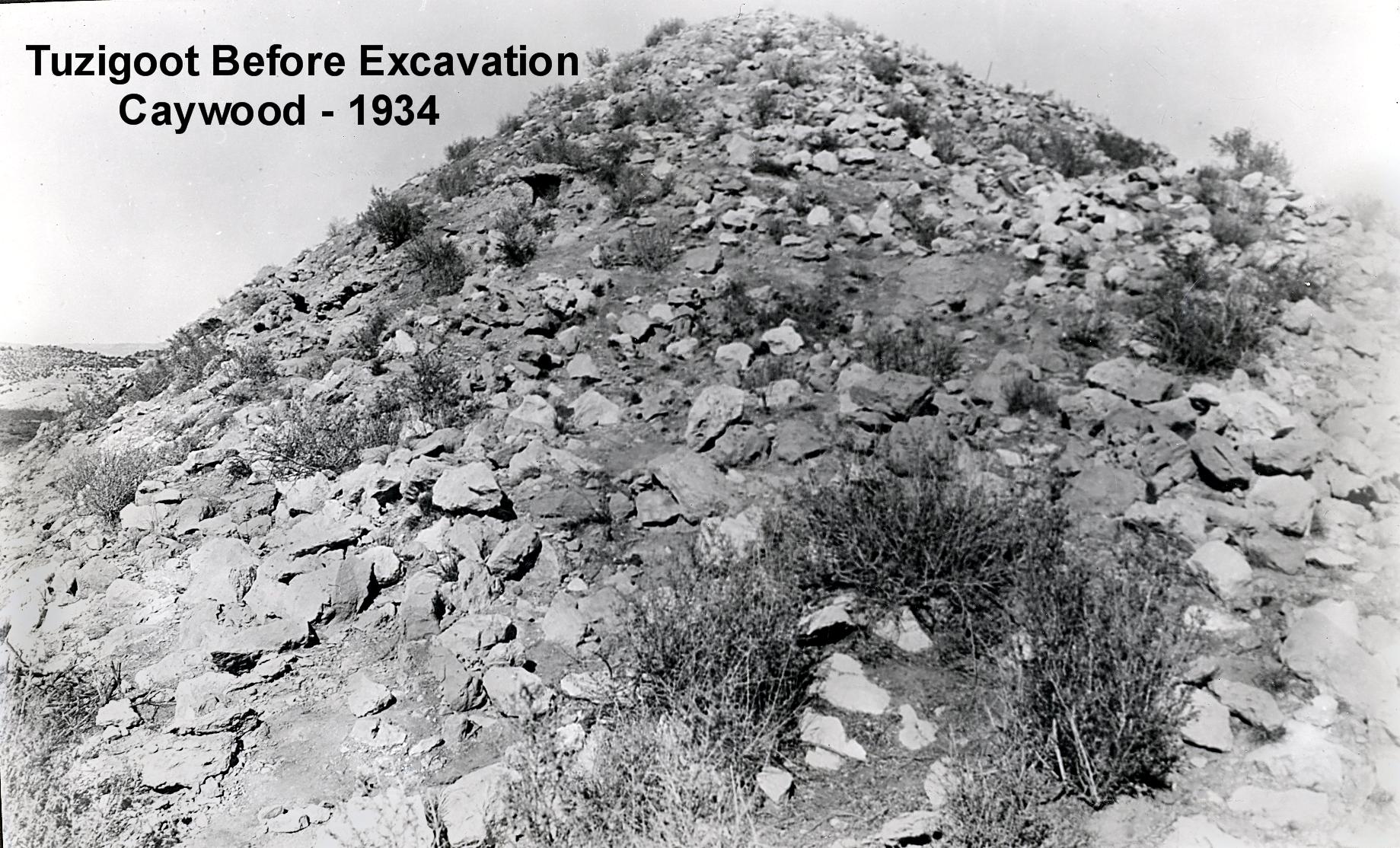
Tuzigoot. That’s right. I said it – Tuzigoot. It’s not a curse, it doesn’t mean anything about aliens, it’s a word from a long lost past. Tuzigoot is the Apache word for “crooked water”. But, if you’re considering going to Tuzigoot, there’s something even more interesting than long-lost words – it’s the fact that the entirety of the ruin was partially hidden when it was excavated in the 1930’s. As I mentioned last week, Tuzigoot is the ruins of a small city, and now is the second National Monument located in the Verde Valley (the first being Montezuma’s Castle). Like Montezuma’s Castle, Tuzigoot was inhabited by the Sinagua people in the 1000’s. Again, like Montezuma’s Castle, the site was mysteriously abandoned in the 1400’s by those same Sinagua people.

Unlike Montezuma’s Castle, however, Tuzigoot was constructed atop a reasonably sized hill with commanding views of the Verde Valley. To me, this is where things get interesting – whereas Montezuma’s Castle was (and is) hidden away from inquisitive eyes for hundreds of years in niches in a slot canyon, the ruins of Tuzigoot were in plain view for hundreds of years. That’s right: the ruins of Tuzigoot were in plain view for hundreds of years – and yet hidden. Now, I know there’s bound to be skeptical readers that are reading this blog and saying, “Yeah right – I know that someone had to have seen those ruins”.


Riddle me this though,  readers: would you have known that ancient ruins lurked here in 1934 had you been walking through the Verde Valley and examining the hill that Tuzigoot stands on at a distance? Would you have? Would you have known that based on seeing something that looked exactly like this: http://www.nps.gov/tuzi/images/20090728174213.jpg ? Personally, I rather doubt it. And, this goes to my larger point that I talked about a week ago: use your powers of observation – there’s always something magical and mysterious waiting to be discovered out in the world. (http://lastadventurer.com/last-adventurers-fieldnotes/2012/5/1/chapel-of-the-holy-dove-kendrick-park-arizona.html) The archeologists and people that worked on the Tuzigoot excavation certainly thought that there were many interesting things to be discovered too!

 Tuzigoot Ruins, Spring 2012

Directions: The National Park Service advises potential visitors not to Mapquest or use Google to find Tuzigoot (aha, here is the evidence of an alien conspiracy, as it is clearly unplottable!) as such services supposedly give you bad directions. Since I’m bad at following directions, I used Google Maps and…..had no problems. Nevertheless, the NPS directions are quite good, so for your convenience, here they are:

“Tuzigoot National Monument is 52 miles south of Flagstaff, Arizona via U.S. Alternate Highway 89A, or 90 miles north of Phoenix. Travel Interstate Highway 17, take Exit 287 and travel west on Highway 260 to Cottonwood. You will continue through Cottonwood on Hwy 89A and go toward Clarkdale. At the first traffic light after turning on to 89A, signs will direct you to turn left to stay on 89A. Go straight through this intersection. This will put you on HISTORIC 89A (designated on the map above as HWY 260) and take you through “Old Town Cottonwood”. As you can tell from the map, Main Street (Historic 89A) does a lot of twisting around. Once you leave Cottonwood you are almost there. There will be a sign telling you where to turn to get to Tuzigoot. You take Tuzigoot Road and follow it to the end…that is where Tuzigoot National Monument is.”

Tips: As Tuzigoot was a small city for a number of years, it also contained the remains of a number of individuals that died during that period of time. According to the National Park Service, the Sinagua people buried the remains of dead children under their living space, in order that they could be with their family. As such, when you are walking around the site, remember to treat it with respect as it is sacred to the decedents of the original inhabitants. It’s also interesting to note that the entrances to most of the living spaces at Tuzigoot were located on the ceilings, rather than the sides, which allowed the inhabitants to maximize the amount of space within the city. The Visitor Center at Tuzigoot also has some great information regarding other former sites in the Verde Valley which used to be within the line-of-sight of the city, and good information about the excavation of Tuzigoot and the Sinagua people.

More Information: http://www.exploring-arizona.com/exploring-arizona-a-fresh-look/parks/tuzigoot-national-monument/,http://www.nps.gov/tuzi/index.htm, http://www.nps.gov/history/archeology/sites/antiquities/profileTuzigoot.htm

Montezuma's Castle National Monument

Montezuma's Castle, Spring 2012

If I was to tell you that out of all fifty states, Arizona has the most National Monuments; chances are you would not believe me. However, this is a fact, as Arizona has eighteen National Monuments, and the next closest state, New Mexico only has twelve. And, for bonus trivia points, the difference between a National Monument and a National Park is that the President of the United States can create a National Monument without Congressional approval and that a National Park must be enacted by Congress and signed into law by the President. Placing questions of law and land use aside, all of the National Monuments and State Parks present in Arizona mean that there’s plenty to do other than go to the Grand Canyon.

One of the more interesting and little known National Monuments present in Arizona is Montezuma’s Castle. The Castle itself is one of two companion National Monuments in the Verde Valley/White Hills region of Arizona, the second being Tuzigoot National Monument (which I’ll discuss next week). Montezuma’s Castle is interesting because of what it is not. First, it is not a castle, it’s a cliff dwelling. Second, Montezuma never lived there. Third, it was inhabited by the Sinagua people – but around 1400 A.D., the site was abandoned by these people, and was uninhabited by the time it was re-discovered by settlers. Fifth, while it’s a great example of Native American cliff dwellings, it’s not even the largest example at the site – the “Castle A” remnants are ruins of a much larger structure. Now, I don’t know about you, but to me any one of these five points provides something interesting to speculate and ruminate on while you visit the site.

 Castle A Ruins, Spring 2012

Directions: Per the National Park Service, you’re going to want to take Interstate 17 to exit 289 (which is 90 minutes north of Phoenix, and 45 minutes south of Flagstaff). From Exit 289, drive East through two traffic circles (I know, bizarre, right? Another mystery – why two traffic circles in the middle of Arizona?) for a half mile (.5) to the blinking red light, where you will turn left and follow Montezuma Castle Road into the park. Once you enter the park, there is ample parking next to the visitor center. Once you have explored the visitor center to your heart’s content, there is a 1/3 (.33) of a mile interpretive trail that leads past the ruins of both Montezuma’s Castle and Castle A. The trail is flat, paved, and contains great views of the ruins and interpretive panels regarding the area.


Tips: Unless you have a time machine, and can travel back to before 1951, you will not be allowed to enter the ruins of Montezuma’s Castle or Castle A (and yes, the National Park Service did allow people into the ruins until that point). However, the interpretive trail does provide some great views of the ruins. While you are on the interpretive trail, you will also be next to Beaver Creek (which no doubt provided water for the early inhabitants and their crops) which is one of the few year-round creeks in Arizona. If you’re itching to actually explore some ruins though, you’re stuck with two options: 1) become a Ninja and sneak in at night; or 2) visit Tuzigoot, which I’ll talk about next week!

More Information: http://www.nps.gov/moca/index.htm, http://www.arizonaruins.com/Sinagua/MontezumaCastle/index.html