Secret Sea Cave, Cabrillo National Monument

Secret Sea Cave, Cabrillo National Monument

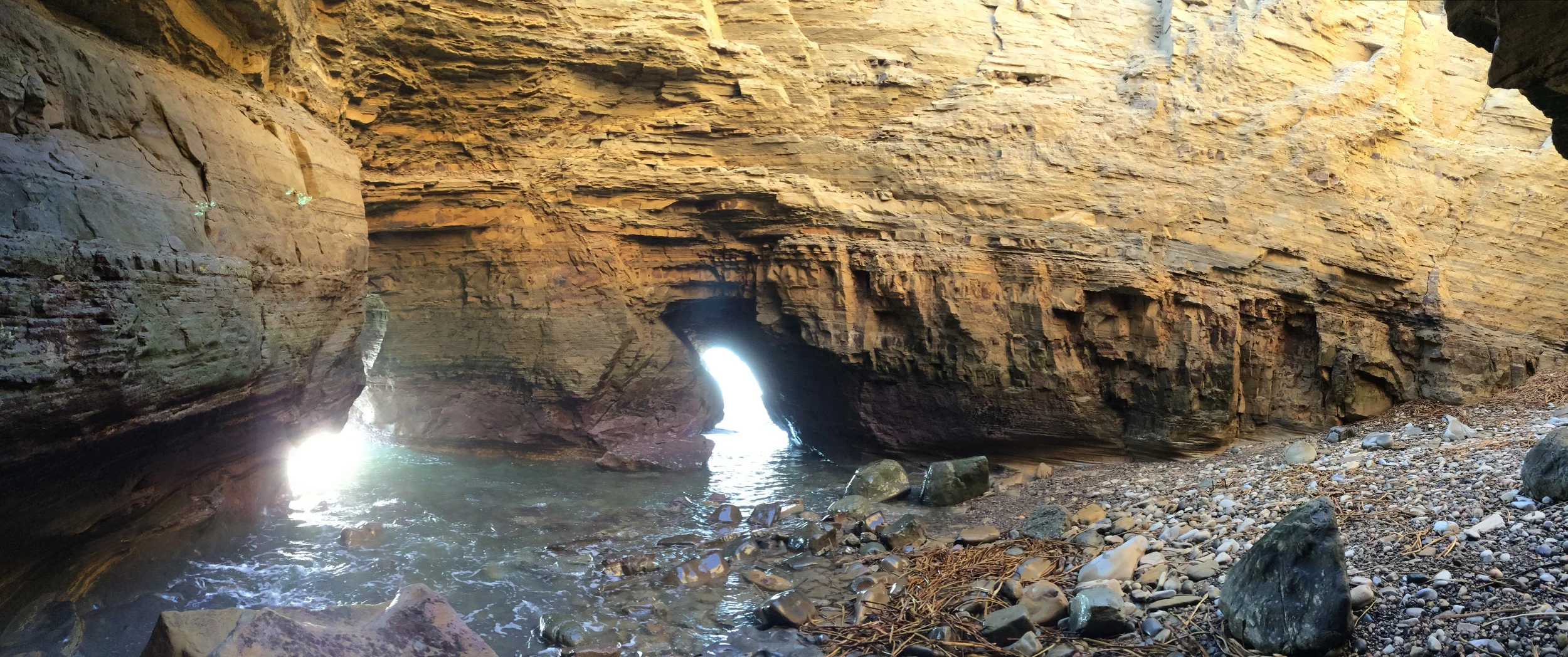
One of my favorite spots in San Diego County is the secret sea caves located at Cabrillo National Monument. In my opinion, the "trail" to the caves in Cabrillo National Monument is also the best "trail" in the monument as well.  At this point, astute readers are probably wondering: “Why is ‘trail’ placed in quotations?” The reason I placed it in quotations is that the best trail in Cabrillo National Monument isn’t a trail;  it's more of an adventure. And, in terms of full disclosure, this trail isn’t for everyone. For starters, it involves a little navigation, a little timing as it is only fully accessible at low tide, and a little swashbuckling. But, if your timing is right, and you are willing to take some small risks, the payoff is fantastic.

Lower Lost Creek Falls, Red Rock Canyon National Conservation Area

Trail to Lower Lost Creek Falls, Spring 2012

After discussing the Calico Hills last week, I received an e-mail that asked me if I knew what the best hike was to do in Red Rock Canyon National Conversation Area. I personally hate answering what the “best” hike is for any area. As I’ve discussed before – the “best” hike in my opinion, is the one that you want to do, which varies for all sorts of people. My second problem with the question was that I’m not that familiar with the area. Sure, I’d been there, and sure, I’d written that blog, and sure, I knew some recommendations, but, the “best” hike? I could name the best hike for a lot of places, but not that place easily. But, fortunately, I didn’t need to have personal knowledge: I had the internet.

Even better than having the internet, I had a good source on the internet: Jim Boone’s site, http://www.birdandhike.com/index.htm. Full disclosure: I’ve never met Jim, spoken to him, nor do I have any interest in his site. In fact, in an age, where a majority of people are promoting their own work (myself included) it may seem strange for me to promote another person’s work. But let’s think about this rationally – who’s the best expert on local hikes in each area? Locals. It’s so self-evident; it almost doesn’t even need saying (although since I’m so smarts, I mentioned this the other day). But, at times it does, especially when research about hiking is involved. If there happens to be a local who has a website, these are the best resources for finding out about things if you are visiting an area. Case in point, if I need information about Death Valley that I don’t know, I’d probably go to Steve Hall’s website (as I linked to in those postings). For the Mojave and Las Vegas, if I don’t know it, I know where I’d go: http://www.birdandhike.com/index.htm. I’ve received plenty of good information from it, especially before my initial trip to Red Rock Canyon. So, that’s what I did: I passed along good information that I knew; and I also recommended this hike here for any level of hikers in Red Rock Canyon, as I found it to be the most accessible hike for all skill levels.

The secret tunnel to Lower Lost Creek Falls

Directions: Red Rock Canyon NCA is located off of Highway 159, and is approximately a half hour drive from downtown Las Vegas (the strip). The park is administered by the Bureau of Land Management (BLM), and at this point in time, if you are going to enter the park from the Scenic Drive entrance (which this hike is located off of), there is a $7.00 day use fee. From the park entrance, the turnoff is halfway across the scenic drive. At this halfway point, you will see a well-signed road marked, “Willow Spring Road”. Turn right on this road and head North for .2 miles, at which point you will see a parking area, pit toilet, and signs for the trailhead. The trailhead leaves directly from the parking lot, and is well signed.

Did I mention this was a hike for all ages and skill levels? It is. It is short, and it is a great introduction to desert terrain, and the terrain of Red Rock Canyon NCA. It is such a good introduction, the BLM has produced a discovery guide with corresponding markers along the trail, and if you are a child (or have a child-like sense of wonder toward the world, as I do), you can check out the link to the BLM program below that is part of their Junior Ranger program. Another interesting thing about this trail is that the terrain present in it is completely different than that found in the Calico Hills. For starters, the distinctive bands of Aztec Sandstone present by the Calico Hills are not present on the Lost Canyon hike, and what rock you do find is a type of limestone.


From the trailhead, however, the trail goes across a flat wash before heading up into some Ponderosa Pines and sagebrush, and passes by the remnants of some Native American sites which are blocked off by fences and BLM signs.

Dry Lower Lost Creek Falls, Spring 2012

Past these sites, the trail takes a couple short turns before heading down a series of stone steps back into the wash. During the dry season, this is the only potential spot you could get lost, as the trail mingles with the wash; but both the wash and the trail leads you to the same spot: the base of Lower Lost Creek Falls. You will know if you are on the trail, however, if you pass through a narrow grouping of boulders that has formed a short “cave/tunnel” which you will pass through before arriving at the base of the fall.

Now, before I receive a number of e-mails stating that there is no waterfall, you should know that this waterfall is a seasonal waterfall, and is fed by snowmelt from higher elevations. So, if it is a dry year, there may not be any waterfall. Or, if it is a wet year, the waterfall and wash may be full of water. Chances are, the later in the year you go on this hike, the less likely the waterfall is to be flowing. When I visited this year, there was just a slight trickle heading down the black section of rock where the waterfall flows. Once you are done checking out the waterfall – or lack thereof, follow the trail back down to where it forks, and follow the other loop over the boardwalk and back across the wash for an easy .7 mile roundtrip distance. This is a great hike, and a great introduction to the park, or a great getaway from the helter-skelter nature of Las Vegas, if you’re a local.


More Information: http://www.blm.gov/pgdata/etc/medialib/blm/nv/field_offices/las_vegas_field_office/red_rock/lost_creek_trail_booklet.Par.5571.File.tmp/Lost%20Creek%20booklet.pdf, http://www.birdandhike.com/Hike/Red_Rocks/Lost_Cr_L/_Lost_Cr.htm

Transit of Venus, June 5, 2012

Good news: the world did not end on May 20, 2012, when the solar eclipse occurred. (http://lastadventurer.com/last-adventurers-fieldnotes/2012/5/18/partial-solar-eclipse-may-20-2012.html). Even better news: the world did not end today (June 4, 2012) when there was a partial lunar eclipse. (http://www.utsandiego.com/news/2012/jun/04/pre-dawn-eclipse-swallows-part-moon/?sciquest). Bad news: the next opportunity for the world to end will be tomorrow, June 5, 2012, when the transit of Venus occurs. I know, right? The word, “eclipse” already sounds sinister, but the word “transit” sounds so much worse. It could mean so many evil, horrible, apocalyptic things. However, in this case what it actually means is that the planet Venus (yes, it is a planet, unlike poor Pluto, or the purported “Planet X” a/k/a “Nibiru”) will pass between us and the sun. This phenomenon will cause Venus to appear as a black dot slowly crossing the face of the sun.

Eclipse, er...TRANSIT OF VENUS Glasses

If that wasn’t cool enough, you should know that the next transit of Venus will not occur until 2117. That’s right – I said 2117. Chances are, unless you have mystic powers from Planet X a/k/a Nibiru that I do not know about (and if you do, please e-mail me), you and I will not live to see the next transit of Venus. As an aside, I’ve also heard that there’s a slight chance the planet could be destroyed in December of 2012 due to some sort of calendaring issue. That means that this could potentially be the last transit of Venus ever. All of these factors make this transit of Venus a must-see in my book. If it’s not a must-see in your book, chances are you hate astronomy, or you have a day job. If it is the former, I have no pity for you. If it is the latter, I advise you do what I am going to do: sneak out of work and stare at the sun – safely.

That’s right: to view the transit of Venus, you will have to stare at the sun again. Let me paraphrase what I said several weeks ago, even though it still should be obvious: do not stare at the sun with your naked (uncovered) eyes. Don’t stare at the sun. Ever. If you stared at the sun at the solar eclipse, and are now blind, this is not a problem for you, and I’m sorry to say that even without you watching, the transit of Venus will still occur. For the rest of us: don’t stare at the sun with unprotected eyes. If you are like me, and you still possess your “Eclipse Glasses” (pictured above), they now are “Transit of Venus Glasses”. Find some white out, white out the “Eclipse Glasses”, and write in the correct term. Other than that, they are perfectly good for viewing the transit of Venus. If you do not own any Eclipse/Transit of Venus Glasses, I recommend you check out your local science museum (Here in San Diego, the Reuben H. Fleet Space Science Center: http://www.rhfleet.org/) to see if they are still selling these amazing items for the low low price of ~$2.00. If you can’t find any Eclipse/Transit of Venus Glasses, find some No. 14 Welders Glasses.

If you are on the West Coast of the United States, the transit of Venus will start at approximately 3:06 p.m., Pacific Standard Time, tomorrow, June 5, 2012. If you are not on the West Coast, do the math, and if you can’t do the math, get someone to help you with the math, because math is more fun with friends.

More Information on the Transit Here: http://www.transitofvenus.org/, http://news.nationalgeographic.com/news/2012/06/120604-transit-of-venus-2012-sun-planet-hubble-space-science-how-when/, http://latimesblogs.latimes.com/lanow/2012/06/transit-of-venus-2012-how-to-view-the-transit-of-venus.html, http://www.utsandiego.com/news/2012/jun/04/tp-a-must-see-event-for-sky-watchers/

Information on how to photograph the Transit here: http://latimesblogs.latimes.com/lanow/2012/06/how-to-photograph-the-transit-of-venus.html, http://www.space.com/15987-venus-transit-2012-lunar-eclipse-photography-tips.html

And, historical context of the Transit here: http://www.latimes.com/news/opinion/commentary/la-oe-0603-wulf-venus-science-20120603,0,3927430.story

Calico Hills Trail, Red Rock Canyon National Conservation Area

Calico Hills, Red Rock Canyon NCA

Las Vegas. A city that’s home to every kind of strange phenomenon in North America. And, perhaps surprisingly enough, a city that’s has some great natural resources and places to get away from all the things one initially came to Las Vegas to experience. To the West of Las Vegas is the Mojave National Preserve, which has some interesting sights (Zzyzxx: http://lastadventurer.com/last-adventurers-fieldnotes/2012/1/13/zzyzx-mojave-national-preserve.html) and some great trails (http://lastadventurer.com/last-adventurers-fieldnotes/2012/1/10/ring-loop-trail-mojave-national-preserve.html). However, if you don’t want to drive an hour or two outside the city, there’s a better, closer option: Red Rock Canyon National Conservation Area.

Red Rock Canyon is one of those places that everyone seems to have heard about in the wilderness community when you mention Las Vegas, but a place that few people have actually visited (other than locals, of course). For years, I heard about how it had great climbing, great hiking, and great geologic features. But, when I asked tough questions like: “What kind of climbing routes?”, “How long are the hikes?”, and “What kind of geologic features are we discussing?” I usually received blank stares. Simply put, everyone has heard of Red Rock, but few people actually know Red Rock (aside from locals). The other day, I finally had the time to head out there, and I now can say that all the speculation about the park is true: it is an amazing place. Even better, I can tell you that there is all types of climbing, from scrambling, bouldering, and aid assisted; that there are short and long distance hikes; and that there are many interesting geologic features out there, including the red Aztec Sandstone bands. (http://www.redrockcanyonlv.org/geology.html). I went on a couple hikes out there, and was struck by how this hike, Calico Hills was a great introduction to the park for all ages and experience levels.

 Some of the smaller Calico Hills - note that Aztec Sandstone!

Directions: Red Rock Canyon NCA is located off of Highway 159, and is approximately a half hour drive from downtown Las Vegas (the strip). The park is administered by the Bureau of Land Management (BLM), and at this point in time, if you are going to enter the park through the Scenic Drive entrance (where this hike is located), there is a $7.00 day use fee. From the park entrance, it is approximately a mile (1) to the first Calico Hills parking area; and a mile and a half (1.5) to the second Calico Hills parking area. A word to the wise: while both of these parking areas are well signed, and impossible to miss, they are quite popular. It is likely that you will not find parking at either of these locations; and will have to continue up the road to the third Calico Hills parking area. During my visit, there was no room in the first Calico lot, despite it being mid-day on a weekday, and I ended up parking at the second parking area.

From any of the trailheads, the Calico Hills trail runs a whopping 3.2 miles from the entrance station to the Sandstone Quarry. (http://www.redrockcanyonlv.org/hikes_map.html) The trail additionally links up to a number of other trails that can be used to make the hike longer. (http://www.birdandhike.com/Hike/Red_Rocks/Calico_Hills/CHTrail_Map-O.htm). The trail is mostly flat and not challenging, and in my opinion, is suitable for all ages. The real attraction of this trail, to me, and from what I observed, was its proximity to the Calico Hills themselves, which are a brilliant red formation of rocks made out of – you guessed it – Aztec Sandstone! In fact, I would say that the majority of the time spent by me and my hiking group was up in the Calico Hills, scrambling around on the rocks. And honestly, why not? If you’re at Red Rock, this is what you should be doing – getting up close and personal with time traveling rocks. Depending on how long you spend on and about the Calico Hills, this trail can take you anywhere from an hour to a day.

Looking down the Calico Hills at more Aztec Sandstone Tips: The other day I was talking about Good Mountaineering Karma (“GMK”), and the Calico Hills is yet another place where this concept applies. When my group and I were scrambling around on the rocks, we came across a father with a very distraught daughter “trapped” on a ledge ten feet above us. While they weren’t in a spot where they couldn’t descend on their own, the girl’s fear had trapped them both. Naturally, I climbed up a little and helped them down to an area that was less steep – GMK, pass it on. The lesson to take from this though is that the Calico Hills are deceptively steep in spots. While most of this area is nothing but simple bouldering/scrambling routes, there are some areas where it is possible to get stuck, and should you not be paying attention, plenty of spots where you can take a nasty fall. As always, be mindful of the terrain around you and your ability. Finally, it is the desert: be prepared with water, food, sun protection, and should you be headed deeper into the Calico Hills, a map or GPS.


More Information: http://www.lasvegasoutdooradventure.com/2012/03/las-vegas-hiking-red-rock-canyon-calicohills/http://www.blm.gov/nv/st/en/fo/lvfo/blm_programs/blm_special_areas/red_rock_nca/planning_your_visit.html, http://www.redrockcanyonlv.org/hikes_trails.php#, http://www.birdandhike.com/Hike/Red_Rocks/Calico_Hills/_CH.htm

Permits, Good Karma, and other thoughts about climbing the Mt. Whitney Trail in 2012

Trailside Meadows, 5/28/12

Permits: As you may or may not know, you need a permit to climb Mt. Whitney. If you don’t know that, then I’d suggest that you read any of the posts I’ve written about Mt. Whitney, as you’ve been required to have a permit for a very long time. What is new is that the Forest Service has gone to an electronic permit issuing system from recreation.gov. With respect to this development, I say, “Well played, Forest Service, way to enter the 21st century”. Seriously. This is a good thing. Gone are the days of when you would – gasp – MAIL your permit application in and wait – gasp – WEEKS – to find out whether you had a permit. Likewise gone are the days of the faxed application. The online application allows you to know what days are available and when you can get a permit immediately. As compared to the old system, the new system seems like magic.

However, there is a teeny tiny dark side to the new system that I have to warn you about. No, it isn’t that you might not get a permit for the 4th of July for your group of fifty people. That wouldn’t have happened under the old system either. It’s that under the new system, things are a little more stringent. Under the old system, things were a bit relaxed: I remember picking up permits at the old ranger station in Lone Pine, from the mailbox after hours, and no one ever really cared when you arrived to get your permit. (And now I’ve made myself sound old…”back in the day, before cell phones…”). Under the new system, the Forest Service does care when you arrive.

Case in point: when I went to get my permit on Sunday for my hike on Monday, I arrived at 2:30 p.m. No big deal, right? Wrong. The computer said that I was supposed to pick up my permit by 12:00 p.m. I was therefore two hours late. A big deal? Not a huge deal, but enough of a problem in that I had to tell the Ranger I was delayed by traffic, which he then put in the computer so it would release my permit. The lesson here is as follows: if you are like me, and you are used to arriving whenever to get your permit, because you’ve always done that, know that you now actually have to pick up your permit at a reasonable time. (More Info about permits here: https://fs.usda.gov/Internet/FSE_DOCUMENTS/stelprdb5333235.pdf, http://www.recreation.gov/permits/Mt_Whitney/r/wildernessAreaDetails.do?page=detail&contractCode=NRSO&parkId=72201)

Mt. Whitney, as viewed from Trail Camp, 05/28/12

Bonus Tip about permits: While you have to have a permit to hike Mt. Whitney, it is not as hard to get a permit as you think. The toughest months to get permits are the following: July and August. That leaves ten other months during which obtaining a permit is not that difficult. Obviously, the longer you wish to stay on the mountain and the larger your group, the more difficult obtaining a permit will be. If you are flexible on dates, and willing to climb the mountain outside of those two months, you probably will be fine. This year, I obtained a permit for Memorial Day a week in advance – and there were plenty of other permits available for day use up to 5/28/12.


Trail Crest, 05/28/12 

Good Mountaineering Karma: Pass it On. In my opinion, there are two types of mountaineers in this world: 1) the type that attempts to summit no matter the cost; and 2) the type that is willing to help their fellow climbers. Personally, I think that Type One climbers are a bit ridiculous at their best; and at their worst, are reprehensible for not helping their fellow man. Obviously, no one should place themselves at life threatening risk of death in order to help another, but aside from that, I feel that mountaineering is a team activity, even if you are climbing solo, and that one should provide support to the best of their ability to other climbers when they can. This is a policy I’ve lived by for my entire mountaineering time, and personally, I’d like to see more climbers adopt it. When I was on Mt. Whitney on Monday, I encountered a patch of ice that realistically, you needed an ice axe and crampons to traverse safely (http://lastadventurer.com/last-adventurers-fieldnotes/2012/5/29/current-trail-conditions-on-the-mt-whitney-trail-may-2012.html). While it was theoretically possible to bypass this area (even though a steep drop-off was around it), as a practical point, it was basically impassable for novice climbers without the proper gear.

 Good Mountaineering Karma: Pass it on and reach the summit!

When I saw this, I first analyzed it to see how I could traverse it safely, and after doing so, looked up at the climber immediately behind me. He did not have an ice axe, nor crampons. I did not know him, in fact, I don’t even know his name now. Directly behind him? A couple that I didn’t know either, also without equipment. All of them were staring at this segment of ice with dismayed expressions. The summit? It was a mile away. That’s right: all of these people had hiked and climbed 10 miles up to potentially be stopped by this obstacle. How do I know they could have been potentially stopped? I heard them discussing it. Now, if I was a Type One climber, I would have: a) not listened to this conversation, because I would have already been down the trail; and b) not cared. 

Since I’m a Type Two climber, what did I do? I cut steps for them to descend. It took me maybe ten minutes. Then I lent two of them my axe as they descended so they could have extra security. The result? All of us reached the summit. If I hadn’t been there, they wouldn’t have reached the summit on that day. The Lesson: good mountaineering karma: pass it on – who knows when you’ll need help to see something amazing. (As an additional aside, I saw plenty of other people using those steps on my descent as well!)

Summer Conditions. 2012 has been a dry year for the Sierras. As I said yesterday, the current snow conditions are what I would expect to see in August normally. This means that in the next couple weeks the remainder of the snow will melt off, and the seasonal flows will disappear. If you are climbing Mt. Whitney this year from this point on, I would strongly recommend that you have enough water for your climb (good advice any year), as there may not be any sources for you to filter water from. This will also aid you in avoiding dehydration and altitude sickness as well. And as always, enjoy the 97 switchbacks and the hike, and don't forget your wag bags!

Current Trail Conditions on the Mt. Whitney Trail, May 2012

Hikers consider the cables on Mt. Whitney, 05/28/12

Alright, just the facts about the Mt. Whitney trail today, I’ll get to my thoughts about the hike tomorrow.

Trail Conditions: The conditions are good for hiking. As I have said innumerable times in 2012, California has had a dry winter, and nowhere is this more evident than in the Sierra Nevada mountain range right now. This is the fourth consecutive year I’ve been on Whitney (2012-2009) around the same time (May to mid-June), and this is the least amount of snow and ice I’ve seen on the mountain in a long time. There is a dramatic drop off from the amount of snow that was present in 2011 and 2010 and I’d say that the amount of snow on Whitney and in the Sierras as a whole is more emblematic of early August than late May!

Yesterday, May 28, 2012, I hiked the Mt. Whitney trail from Whitney Portal to the summit. I got an early start, leaving the Portal at around 4:00 a.m. from the overnight hikers campground, and I was carrying the gear that I discussed in Thursday’s post. (http://lastadventurer.com/last-adventurers-fieldnotes/2012/5/24/gear-list-for-a-single-day-ascent-of-the-mt-whitney-trail-sp.html). From the Portal, the trail is clear of snow, ice, and mostly all debris all the way through Trail Camp and up past the first section of switchbacks ascending Mt. Whitney. (There are some small deadfalls on and around the trail, but there are trail crews out and working on these areas, and these spots are nothing to be concerned about). From what I saw, I would say that the snowline is currently running at approximately 10,000 feet or higher, although some very very small patches of snow do exist between 9,000-10,000 feet. The standard creek crossings prior to Outpost Camp are flowing, but due to the dry winter, such crossings are low, and likely to subside within the next couple weeks.

The remaining snowfield on the chute, 05/28/12

Since there were no obstacles or other problems, I rolled through Trail Camp at around ~7:35 a.m. At that point, most of Trail Camp was stirring, and I took the opportunity to climb up the first section of switchbacks to where the snowfield from the Whitney “chute” stopped. My plan was to climb the chute as I had done in 2010/2011 in order to avoid six miles of hiking on the switchbacks. However, even though it was a cool morning (at that point it was around 30 degrees, with a steady 10-15mph cool breeze coming from the West, off the mountain), the snowfield next to the switchbacks was already fairly soft and sloppy. I traversed approximately fifteen feet into the snowfield to satisfy myself that the snow was indeed slushy, and not just melting by the edges; and I found that it was very sloppy, slushy, and the consistency of a slurpee pretty much throughout.

At this point, it was around 8:00 a.m., and I knew that it would only be getting warmer in the chute and on the snowfield with the sun shining directly on it for the next several hours. As I had no desire to repeat my experience of 2011, when my group and I slogged up the chute in molasses-like conditions, I elected to continue up the switchbacks. At that point, 8:00 a.m., there was a team of climbers leaving Trail Camp who had the gear to ascend the chute (ice axes and crampons) and elected to take the chute rather than hike the switchbacks with me. By the time I reached Trail Crest, I could see them only a quarter of the way up the chute; and they eventually elected to turn back to Trail Camp as they were exhausted from attempting to traverse the sloppy, slushy snow of the chute.

View from Trail Crest, 05/28/12

It’s also worth noting that there are many exposed rocks and boulders in the chute at this point in time, as well as other unseen hazards that are likely lurking underneath the surface.  While all of this discussion about the chute is likely academic, as the remainder of it will probably melt off within the next two weeks, I would not recommend that anyone attempt it at this point in time unless they are climbing it while it is still frozen – i.e., before 8:00 a.m. I did speak to one climber who summited yesterday who did take the chute – but he traversed it at 6:00 a.m., and walked back down the switchbacks. As far as I’m aware, he’s the only one who made the summit yesterday who did take the chute.

As for the switchbacks, the first third of them are completely snow and ice free and are in good condition. The place where snow and ice becomes an issue is at the cables. While the first section of the cables has snow against the mountain, they are passable. However, the last section of the cables and trail is blocked completely by a mass of ice (and some snow)(as pictured). Due to the steep drop off next to the cables, this is a bad spot for a large mass of ice and snow to be. At this point, there were a number of people surveying the situation, with most parties electing to turn around rather than risk a fall. There were a number of people (myself included), who elected to proceed around the cables as best as possible. Even though I had crampons and an ice axe, I decided not to use them at this point as I saw them as being of no benefit in that situation. Instead, I managed to lever myself around on the cables before proceeding up the trail. This seemed to be the popular approach to the problem; but obviously, judge the conditions and your skill level accordingly before attempting to pass. Again, I imagine this is an academic discussion, as this obstacle is melting out and should be completely passable within the next two weeks, I would think.

Final snowfield near Whitney summit, 05/28/12

The remainder of the switchbacks and Trail Crest were also mostly free of snow and ice. From Trail Crest to the summit, there are a couple of patches of ice and snow; and there was one problem area near the “windows”. This problem was a four foot by three foot block of compressed ice lying up against the mountain on a downhill section of trail. Directly past this area was a drop off of twenty to several hundred feet. At this point, even though it was a short distance – four feet, maximum, I elected to use my ice axe and crampons. The ice in this block was very solid. Once I was back on the trail, I cut steps in the ice for the three climbers behind me in order that they could safely continue their ascent. While I’m not sure if a fall from this spot would be immediately fatal, it certainly seemed more treacherous than the segment by the cables to me. I also think that this obstacle will remain on the trail for a longer period of time, given that it is solid ice in shadow at a high elevation. From the windows to the summit, there were a few sections of snow on the trail, and a last snowfield (also slushy in the mid-afternoon) that was thirty feet across.

The summit itself was nearly completely snow-free, and I summited at around 11:15 a.m.(http://youtu.be/j364VWB-rPA) Due to the wind, slushy chute, obstacles near the cables, and other standard mountaineering issues, there weren’t many people on the summit yesterday. I passed four people coming down on my ascent, and was joined on the summit by five other people. At the time of my descent (~12:00 p.m.), I passed four people who had a reasonable expectation of summiting, leaving the mountain with an unofficial summit total of 14 people, somewhat low considering there was a lack of snow on the trail. Nevertheless, it was a great hike, and I’d say that within two weeks, there will be no need to carry ice axes or crampons, as there will be no snowfields or other snow related obstacles.

Gear list for a single day ascent of the Mt. Whitney Trail, Spring 2012

Note: The gear in this photo is not the gear talked about below!

Back by popular demand, it’s the list of gear that I will take up Mt. Whitney in a few days. As always, know the conditions and do not follow my recommendations blindly. Equally as important, know your own body, which will help you determine which items are best for you to keep your core temperature in the proper range during the ascent. As I noted yesterday, the weather on the mountain can change rapidly; and you will need to have the clothes to withstand such climactic changes. Chances are, unless you are some sort of alien, your body will go from cold to hot and back to cold during the hike, which means you will need to layer appropriately to avoid heatstroke or hypothermia. Last, just because I reference a piece of gear in my list that I am using does not mean that you need to have the exact same piece of gear – certain manufacturers make similar gear; some gear I am using may (gasp) be several years old, but reliable; and some gear from other parties may fit you better. Use your best discretion in utilizing this list as it is a mere guide, not the end-all-be-all of gear lists, but you can also be assured that I do know what I’m doing as I’ve been up this mountain 11 times, and summited 7 times, in addition to all of the other mountaineering that I’ve done. So, without further ado, here’s the gear I’ll be taking:

Mandatory (Meaning, I have to have it for the climb in May 2012, and if you are going in May 2012, you should probably have it too):

1)      Backpack: I run a slightly larger Arc’teryx daypack that I’ve been using for several years now. I’m not sure what the model is, but it’s served me well, and I like how Arc’teryx gives you comfortable padding on the shoulders/back/hipbelt. Whatever backpack you are bringing, I suggest that it has a spot to either strap on your ice axe or a loop to attach it. 

2)      Ice Axe/Crampons: At this point in time, there is snow/ice on Whitney, and if you are looking to ascend and descend safely, you will need these tools and the knowledge of how to use them. Both my ice axe and crampons are made by Black Diamond, but there are other solid brands out there. Make sure that the ice axe is sized for your correct height, and the crampons fit your boots ahead of time.

3)      Water: I carry a full four liters, mainly because I like to stay hydrated, which helps with the altitude, and because I hate stopping to filter water. I also like to have extra in reserve for emergencies, and as a bonus tip I’ll admit that I actually carry five liters, in that I’ll probably drink a liter before heading up the trail.

4)      Clothing (to wear): I’m going to be wearing a set of breathable hiking pants; hiking socks (good socks, almost as important as good boots); mid-weight fleece long underwear top; and I’ll bring a soft-shell fleece jacket that’s heavy for two reasons: 1) no need to carry an additional waterproof shell; 2) it will keep you warm when you do stop/protect you from the wind. Chances are I won’t put on my jacket until I get to Trail Crest; at which point I’ll also change my top despite it being a wicking fabric. I will also bring a pair of gaiters, because no one likes snow inside their boots.

5)      Clothing (reserve): Since you don’t want to carry much weight on a one-day climb, you want to keep your reserve clothes to a minimum; while leaving you with room for margin should you need them. Since I carry a soft-shell fleece, I don’t carry an additional jacket. What I do carry is a set of long underwear bottoms, and an extra long underwear top to wear from Trail Crest down. That’s it. The only way I would consider carrying extra clothes than that is if I knew the conditions called for extreme cold or weather, in which case, a lot of things would be different.

6)      Hats: I carry a fleece hat for cold; and a brimmed hat for sun.

7)      Boots: I will be using my set of Asolo Mountaineering boots that fit my crampons. The only good piece of advice I can give you about boots is that you should never take a brand new pair of boots on this hike that have not been broken in. Other than that, it’s personal preference.

8)      Food: Again, for a day climb, you shouldn’t be looking to eat gourmet meals. This again is a personal preference area, but you have to eat. For starters, you are going up 11 miles, and ascending 6,000 feet – you will be burning calories at an amazing rate. If you’re not eating, chances are you’re not going to make it because your body will run out of energy. I personally take energy bars and other high protein sugar fare, and munch through the day, knowing that I can have a good meal the night before and the night after. If you want to take sandwiches/cook food, know that you will be either: a) carrying extra weight; b) taking extra time. If it’s in your timeframe/plan, good for you; I pretty much only stop at Trail Crest and the Summit. Also, as another bonus tip: watch out for marmots when you do stop, because they are looking for food and quite aggressive, and will chew through packs, tents, and other items if you aren’t attentive.

9)      10 Essentials: Some of these are covered above – food, water, clothing. The ones that aren’t – such as matches, water purification tablets, emergency blanket, knife/multitool, map/compass (or GPS), sunscreen, sunglasses, and first aid kit, to name a few, you should have on your person. Even though Whitney is a popular trail, you should always be prepared.

10)  Wagbag/TP: Everyone poos. Chances are you will need to use it. Best bonus tip you will get: bring an extra bag to put the wagbag in, in case of leaks/spills and to cut down on the smell.

 The infamous "Wagbag" - everyone poos!

Optional Gear (You might want it; then again, you might want to save the weight).

1)      Camera: I’ve been to Whitney a lot, so at this point, I rely on my iPhone to get the shots/video. It works great and saves weight.

2)      Trekking Poles: I hear these save knees, but I’m not quite ready to sign up for a set just yet.

3)      Additional Clothes; additional food; additional water; or anything else that you think you need/want in particular. If you think you’re packing too much: you might be – don’t be like this guy here: http://youtu.be/ZzUDr3wdOac, and like me, enjoy your hike/climb!


Going for a Two Day Climb? Check out this list here: http://lastadventurer.com/last-adventurers-fieldnotes/2007/12/10/the-las-list-of-gear-for-whitney-october-19-20-2007.html